"Peak Oil" generally refers to peak oil production. This article is about peak oil demand.
Overall, this should be considered a good thing.
As people convert to alternatives which are cheaper - due to renewables improving - the demand for oil in some industries decreases. Which then drives further innovation into those areas and further alternatives. In fact, this is exactly what critics of peak oil have been saying for years.
(This isn't saying demand for oil will go to zero, just that it is likely to start decreasing.)
Peak oil refers to production, meaning once we reach peak, we will never be able to extract more from currently known means. Oil is funny. There is plenty of oil, but much of it is too difficult to harvest from an economic standpoint. That's what makes shale oil techniques such a breakthrough. It's economically easier to get to what was once not.
From Wiki.
Peak oil, an event based on M. King Hubbert's theory, is the point in time when the maximum rate of extraction of petroleum is reached, after which it is expected to enter terminal decline.
It's also worth noting that "too difficult to harvest from an economic standpoint" is a moving target. If prices go up, oil which was not possible to extract profitably can become profitable. That means that "running out of oil" won't happen absent some crazy government intervention, since as supplies dwindle, prices will go up, and new oil will become profitable to produce.
This is worrying in terms of climate change because "difficult to harvest" usually means "energy-intensive to harvest." For example, tar sands require expending around 20-30% of their energy content to extract them in usable form, which means that CO2 emissions from burning that oil are effectively 20-30% higher.
If peak demand means we'll be able to leave the most difficult oil in the ground, that's excellent news.
>It's also worth noting that "too difficult to harvest from an economic standpoint" is a moving target.
Good note. Oil is fairly inelastic. I would say terminal velocity on that would be just before it costs the same amount of energy to extract energy. That can be converted to dollars just as well. That's a good thing about renewable and alternate energy, it erodes that inelasticity so when terminal velocity hits, we aren't all breeding horses again.
It is a good thing on the long run but 3-4 trillion debt is tied up in fossile fuel economy. If that transition happens too fast thsts not a good thing.
Debt balances with assets across humanity - that number doesn't mean we owe $3trn to aliens.
Some of the $3trn shows up as assets in pension funds and SWFs, but much of it is hiding in the balance sheets of oligarchs and middle eastern monarchs.
The idea is that carbon fuel dependent industries, which is a lot of industries and infrastructure, have issued vast amounts of debt to fund investment and medium to long term expansion and operations. If the transition to e.g. electric vehicles and solar power generation happens rapidly many of those investments will become massive liabilities and the debt will go bad. This would also lead to a crash in oil prices, so only the cheapest producers would be viable, leaving the rest sitting there on huge oil production infrastructure rusting away, with even more bad debt it will never be able to repay.
I'm not sure how likely/unlikely this is, but that's the theory.
You're arguing that the problem with Donald Trump is that he's too green and/or too into creative destruction, and will cause the oil industry to implode?
No, I think the implication is that if oil workers lose their jobs, while Trump promises to "make oil great again" (he's certainly threatened to cut funding for green energy), oil workers might vote for Trump.
I meant only that when the structure of the economy changes to quickly, reactions like Donald Trump occur. If the US had been better about integrating all the people employed by manufacturing into the "new" economy I don't think they'd be so desperate for the kind change they think Donald Trump represents.
That's not how the economics of mineral resources work. The marginal cost is increasing with volume, because the resources become harder and harder to find. Economies of scale only operate on the scale of individual extraction operations, which individually are vastly smaller than the overall market. That is, if demand goes down, it will not be that the same extraction operations are run at half speed, losing economies of scale. Instead, the most expensive such operations will simply never be started, and the price will fall to reflect the new cheaper marginal cost.
There's a great report from the UK that analyzes the losses of stranded fossil assets if we're to hit our climate change goals. It says that in order to cap at 2C warming we can only pull up 1/4 of our existing proven reserves, and only 1/3 to cap at 3C. That means stranding over 2/3rds of our fossil assets. Also, the situation heavily favors producers who have cheap assets, which are mostly sovereign producers in the middle east. The private producers like Shell end up having to strand way more than 2/3rds because the get pushed out due to low prices.
Well, you have to also keep in mind that a lot of those reserves were proven at an oil price of >$100/barrel. I don't remember offhand the numbers for what percentage of proven reserves are commercially viable today, but I spoke to someone in Shell a few weeks ago about North Sea developments. He said that in unconventional plays, basically only polymer-EOR is profitable at current price levels, while ultra-deep fields, CO2-based EOR and arctic fields are generally all unprofitable. My guess is the same goes for Gulf of Mexico ultra-deep fields, as well as Brazilian pre-salt.
I also know that several of the small brownfields in the North Sea are being operated now at a loss, because that costs less than plugging and abandonment.
So it's perhaps not that far fetched to think that 2/3rds of current proven reserves will not be developed if the current economic situation persists.
> It says that in order to cap at 2C warming we can only pull up 1/4 of our existing proven reserves, and only 1/3 to cap at 3C.
This is assuming that the extracted oil is burned, though, right? If a new industry emerges making, say, huge plastic spaceships, then it may still be profitable to extract all the oil we can get.
Only about 7% of oil isn't burned. So you'd have to grow the plastics, asphalt, etc. industries by 10x to make up for the 2/3rd stranded assets. That's a lot of plastic spaceships and parking lots.
I once read an article explaining that storing oil is definitely not easy. IIRC, it was super toxic, abrasive, could easily be set on fire, and of course, super valuable => you need almost a bunker to store it...
I think Tim Flannery (though probably not the first or only one to) proposed the benefits of retaining a huge volume or oil & coal in case we ever need to thoughtfully kick-start a greenhouse effect.
And parking lots are going to take a huge hit regardless, with some mix of population decline in first world countries (less cars overall), self driving cars (again, less cars), and populations continuing to migrate to major population centers (mass transit > cars).
And since this is not going to happen, and carbon sequestration takes more energy than we gain from the remaining oil, an articifial volcanic winter is probably going to be the only way out. Main problem: Kiss complex oceanic life goodbye - 2C warming will already be enough to pretty much kill all the coral reefs. Getting a cooling effect but with a continuously increasing ocean acidity will be devastating.
Nature will be fine, she's been through worse. It's humans who are in for a rough time.
From some of the pentagon reports, it sounds like major wars over food and migration start breaking out at 2.5-3C, if not sooner. At 3-4C it's likely to no longer be confined to developing nations.
Both nature and humans will be in for a rough time, and both will survive, but not unscathed. Coral reefs and many other vulnerable ecosystems will get seriously damaged. Something will eventually take its place, but in the mean time, a lot of species will be going extinct.
That may not be quite as pressing an issue for us as war and famine, but it's not the same thing as "fine".
There are only really two scenarios in which nature will be fine. Humans wipe themselves out, or humans build a long term (billions of years) sustainable civilization that maintains extensive nature reserves well stocked with viable and sustainable populations of wildlife with no interruptions or reserve management screw ups for the rest of the life of the solar system.
Is there a chance that evolution will mitigate the rising temperatures and ocean acidity? Or are there perhaps levels those things that are fundamentally negative to life in general? Or is evolution too slow or too unpredictable to come out as a anything other than a net negative for humans?
With very high certainty (with some slight chance that Earth becomes the next Venus and evolution here ends for good).
Keep in mind though that a mass extinction is part of the process of accelerating evolution. You don't get a quick adaptation without a strong selection process.
Edit: By 'slight chance' I mean very much near zero btw. However I'm skeptic enough of climate models to know that they aren't good enough to include all the domino effects we've never seen. The Permiam-Triassic boundary saw tremendous forest fires along with abrupt methane release, and that didn't include a species actively releasing enormous amounts of fossilised carbon. I'd imagine that if a few worst case scenarios came together - finding more fossil fuel sources, burning up all of it and causing unstoppable forest fires in all large remaining forests, it could happen.
Evolution will solve it eventually. The problem is the timescale. It's a common argument that climate change isn't a problem because the Earth has been even warmer in the past. That's true, but misses the point. The problem isn't merely that the climate is warming, but that it's warming extremely quickly. Nature adjusts, but nature takes a long time to do it. If the temperature goes up by 4°C in a century, that's far too fast.
On the specific question of evolution, major changes happen on a timescale of thousands if not millions of years. For example, despite huge changes in our environment, humans today are basically the same as they were tens of thousands of years ago.
Earth will probably return to something like an equilibrium, both in terms of climate and in terms of wildlife, in a million years or less. But that doesn't do us any good when the threat to our civilization, from climate change and ecosystem collapse, is in the next century or two.
I know that I was vague with using the word 'complex', but 96% of all marine species, with only small, 'squishy' (low calcium carbonate content in bodies) species surviving, is enough for me.
It's also interesting to look at what probably caused that particular, so far most devastating extinction event.
If you talk in the time scales of millions of years, yes. Otherwise it is not true. Global warming has the potential to eradicate most marine life as we know it. And once it is gone, it is gone for all the time scales relevant for humanity. And we do not know how far the ecological impact would be. Just killing the coral reefs would be a tragedy, but if we are unlucky, this triggers enough eco systems to collapse that also our direct survival is endangered.
1. Through over-fishing, exploitation and pollution the higher marine animal populations collapse. Coral reefs disappear.
2. After several generations nobody alive has ever seen a coral reef, a whale or dolphin. Most of the 'attractive' marine environments are heavily compromised so nobody is interested in preserving the marine environment anymore as it's mostly gone already.
3. Humans develop a global stable civilization.
4. After a million years or so the remaining marine habitats and life forms have heavily adapted to the new environment. Few to no higher animals remain that resemble their 'natural' forms. Humanity comes to regard these as vermine.
Project the above over another couple of billions of years.
Most of the "fossil assets" are in the form of coal. The good news is that most coal is burned in fixed power plants which can readily be substituted by other electricity sources, and that is economical today. Oil is a problem too, but a smaller one.
this is new and a little lightweight (don't sign up for their email, it's got some really insulting promotional stuff):
http://oilprice.com/Energy/Oil-Prices/
AKA "Oh don't worry about regulating us and protecting the environment, it will naturally happen in five years when your need for us will surely peak!"
Did you read the article? Shell said "we are going to be fine, because we are switching our business to things natural gas and biofuels"
What most petroleum companies say, as the article indicates, is that oil demand is going up for a good while longer. That's because if the idea gets around that demand is going to peak, they won't be able to borrow the gigantic amounts of capital they need to keep drilling new wells.
> That's because if the idea gets around that demand is going to peak, they won't be able to borrow the gigantic amounts of capital they need to keep drilling new wells.
Alternative hypothesis: it's simple denial, much like Nokia and more recently RIM.
Alternative alternative hypothesis: they're correct, because the move towards renewable energy and electrified transportation is more than offset by increased oil consumption caused by economic growth in poor countries.
I don't understand that idea. From what I understand, most oil is used for transportation, so if EV's get cheaper than ICE, which it seems is going to happen in less than a decade, won't all the newly-prosperous developing world people buy EV's instead?
I'd be surprised if it happens that quickly for the low-end cars that newly-prosperous people in third-world countries would buy. Even if it does, insufficient electrical infrastructure might get in the way. In any case, I'm not saying it must happen this way, only that it's a possible basis for such a prediction that doesn't rely on oil companies being stupid or duplicitous.
The oil producers are actually calling for a carbon tax, and have been for a while. It's the american coal industry, and their influence on the rest of the fossil fuel industry that's holding it back.
Looks like the market cap for US traded coal companies is only $4 billion[1]. Maybe a US multi-billionare could buy them out as a philanthropic act and reduce mining to only that needed for chemical stock.
Holland absolutely isn't, we hardly do anything about our CO2 production. Possibly the worst in the EU. We opened a new coal electricity plant in 2016!
"The Aegean Collapse has been attributed to the exhaustion of the Cyprus forests causing the end of the bronze trade. These forests are known to have existed into later times, and experiments have shown that charcoal production on the scale necessary for the bronze production of the late Bronze Age would have exhausted them in less than fifty years."
Whether it is 5, 15 or 50 years hence, peak oil demand will surely come. Technological innovations will see to that. The question I have is what will that mean for all our friends in OPEC nations? Venezuela is in most estimates already a failed state and thats simply due to mismanagement. What happens when structured demand erosion starts to take hold and no amount of state level management can stop it? For those who say poverty breeds desperation breeds terrorism (which I don't ascribe to) we'll no doublet be in for a few volatile decades indeed until it all gets sorted.
If we take Nigeria as an example: Their oil industry is worth about 10% of GDP [1] so if it were to halve in, say, 20 years you are looking at a drag of 0.25% GDP per year. And since oil profits mostly benefit only an elite group of kleptocrats, the average Nigerian will hardly notice the effect. In fact, it may be beneficial for Nigeria because it would greatly reduce the 'resource curse' and force government to be more accountable to the people [2]
Rich people hate losing their money. I do not know how, but I am sure the average Nigerian would feel the effect somehow. It could take any form but one I thought of is some kind of contrived import tax could be created to 'encourage' to locals to buy local oil instead of foreign solar panels.
Oil price collapse in Alberta led to the election of its first not-super-right-wing gov't since the 1930s. It's since become fairly unpopular (something about not being able to wave a magic miracle wand and make oil prices go back up, so everything is their fault) but it's an interesting rupture.
Normally people use the term "demand" to mean a curve, which is a function of price. In an efficient market (a good approximation for the oil market), the price solves for the equilibrium between supply and demand. The quote in the article, "demand will peak before supply", is meaningless. It's not wrong, it's just not saying anything.
The fact that the price has come down in the past couple of years means that either demand has shifted down (that is, keeping the price constant, people demand less) or that supply has shifted up.
On the demand side, it's unclear to me, I'd appreciate any pointers others would have. While advanced countries get more efficient with their use of energy, emerging economies are increasing their demand as more people escape poverty.
What is clear is that the supply curve has shifted up. Both because of technological improvements in the U.S. in fracking, and due to political improvements in countries like Iran, Iraq and Nigeria.
Prices are low primarily due to unrestricted output from OPEC, the addition of Iranian oil with the lifting of sanctions and the massive increase in supply by American frackers.
There's too much distortion in the signal to confidently draw that conclusion. Particularly in oil, where the middle East has huge reserves of stuff that's easy to reach but for the unstable states on top of it; and where the rich countries have been throwing away unfathomable amounts of capital to reach small pockets of oil that diminish rapidly.
The oil price market is too volatile to say that. I think we'll see at least another couple cycles of low price - ultra high price before we can say (in retrospect) that peak demand was hit.
It's a shame that the Canadian stock market is so tied to oil exports, because it means a good chunk of retirement income is tied to that value for a whole lot of people. It's quite bleak. Especially considering that oil exports as % of the Canadian national GDP is nowhere close to the % of value it represents on the Toronto stock exchange.
In my lifetime I have learned that the only prediction I can believe regarding peak oil is that there will always be another prediction about peak oil. I'm not saying it's not gonna happen (or hasn't), just that it's been said so many times before.
This is not a prediction about peak oil but about peak demand.
It has ties to fear about converting to solar and battery powered economy too fast, when more than 3 trillion dollars of debt is tied up into fossile fuel economy.
PeakOil-the-movement shares the same strenghts and weaknesses of many other engineering spawns: The stuff they predicted got all the technical details correct to a remarkable degree, yet they failed to grasp the economic and political implications, and made a communication fiasco out of it. I find it very sad and ironic.
I'd urge you to not throw the baby out with the bathwater. I can share that I have taken life decisions under the assumption that resource depletion will be a real socioeconomic force during the second half of my life; yet you will notice that ditching my programming career and moving to an organic farm in the middle of nowhere were not among those decisions (yet).
Not who you asked, but the two biggest questions that I ponder along this line: (1) How can I preserve some of my savings in real assets so that they won't evaporate when the bond market finally crashes and takes the dollar with it (probably a few crashes from now)? (2) Given the nature of just-in-time logistics and our complete dependence on trucks, will I be somewhere that I can limp along once oil hits a price that makes that all infeasible? Or will I be a sitting duck, waiting to die of hunger, thirst, or heat exhaustion? And (3) am I preparing myself with skills outside of work that will help me sustain myself when I have to work a little bit lower down Maslow's pyramid (first and foremost, maintaining fitness?) I don't work in programming at the moment, but my job ceases to exist if we lose our ability to have high-precision manufacturing and logistics chains spanning an entire continent.
"Be a Westerner" is quite a good place to start for all of those, nonetheless.
I suspect the "decline" looks a lot like the intermittent de-industrialisation we've already been seeing. There are plenty of towns which have lost their key industry without replacement, so they're just kind of limping along. The burden of decline will fall mostly on those already at the bottom.
Basically... avoid indulging in a lifestyle of conspicuous consumption, be very conservative with the debt I allow myself to take on (used strategically, not just to prop-up expenses), and choose the machines I bring into my life with an eye towards energy efficiency and repairability.
Careerwise, I have avoided going with the pull of migrating to our industry's big centers (the most known being Sillicon Valley), since I consider those places to be unsustainable. If I were young and single, I may have gone for a couple of years to gain a quick buck, and then get out; but I am a middle-aged father or two now, and don't think it is worth it even today to subject your family to that kind of pressure, just for the sake of being one of the cool guys.
This will not save the world at all (not that it is the world that needs any saving), but hopefully puts me and my family in a less exposed position for the consequences of resource depletion.
Yes, I understand that sounds odd. The keyword you probably are missing is middle-aged. I brought those guys into this world before I had any awareness on these issues.
But even if that had not been the case, I think in spite of the very hard challenges ahead of us, there's much reason to go ahead and take on the future with a positive attitude. Not wishful thinking, but recognizing that there's both good and bad in this life. And the good makes it worth living, even if the bad makes it harder and more bitter.
It is one thing to live your life under the assumption that your every wish is going to be magically granted, and that you are entitled to as much stuff as you want. It is another to turn all crazy and suicidal over some paranoid apocalypse fantasies. I wish more people would understand there's a lot of middle ground between those 2 extremes.
I hear you on peak supply, which has always been a moving target due to discovery of new source or method of extraction.
But projecting oil consumption has been fairly stable. In fact, it's basically been a straight line for the past 50 years, with couple of temp spikes.
And based on that, predicting peak-demand might be a bit easier, though 5-15 year sounds overly aggressive given the fact that much of the world is under developed.
But who knows... there could be a miraculous discover7 in alternative energy (or battery tech)
I would speculate about it more in terms how under developed countries went straight to 3G/4G cellular, perhaps skipping earlier radio tech and maybe even some degree of wireline tech (this part is grossly oversimplified in journalism, but there is some validity to needing less lowband wireline infra). Maybe that second caveat delivers further insight, i.e. I would expect diesel to outlive gasoline by 20-40 years. Diesel is like a capacity 3.5" enterprise disk while flash underwent yield, density, and longevity development.
The problem, if you want to call it a problem, is all Hubbert extraction curves are fractal self similar. So some field in Pennsylvania decades ago looks like Texas the state decades ago looks like Mexico production "now" looks like world production estimates... may as well just publish one graph for them all. That unusual self similarity of all oil production graphs at all scales and all locations on the planet is kinda the whole point of the topic.
It's not "oil is running out", it's "demand for oil will drop", which is the other side of the equation, and definitely a good thing (except for oil companies that don't prepare for it).
If we know anything, it is that these guys (energy industry) are pretty terrible about predicting much of anything. Ironically, it was an engineer at Shell that started "Peak Oil" in the 50's... one, M. King Hubbert.
Maybe monster trucks will take over as the prophecy of the film Idiocracy come true and oil stages a massive come back... you heard it here first!
I think you have to distinguish between Peak Oil (point in time where there is the maximum rate of extraction) and "Peak Demand", which is what the article is about.
Furthermore, Shell is actually well-known for its effective foresight activities (particularly in the 70s). Maybe because they switched from forecast to foresight...


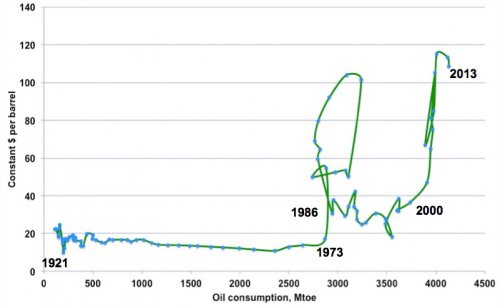
Overall, this should be considered a good thing.
As people convert to alternatives which are cheaper - due to renewables improving - the demand for oil in some industries decreases. Which then drives further innovation into those areas and further alternatives. In fact, this is exactly what critics of peak oil have been saying for years.
(This isn't saying demand for oil will go to zero, just that it is likely to start decreasing.)