Nice to hear. Concorde was a beautiful airplane, but limited to '60s technology (it even had vacuum tubes in the flight deck computers). But it did pave the way for a lot of technological advances at that time, such as carbon brakes etc.
Be good to see what engineers can come up with using current technology to make things stronger, faster and lighter.
Always intrigued by the fluctuations in the airline industry. I remember a time when it was said 'smaller aircraft were dead, and it is the time of the super jumbos', and now the reverse is true with airlines shunning huge aircraft for smaller aircraft that can do regional hops.
Given that the R&D and deployment process for a new aircraft type is measured over decades, it would be incredibly difficult to build a plane today that will fit the market in 10 years time. Hats off to Boeing, Airbus, Embraer et al for their efforts.
If you like that thread, I can really recommend this book: Concorde New Shape in the Sky by Kenneth Owen.
There are two editions of the book. The first edition is super cheap (eg. 29p + postage: https://www.amazon.co.uk/d/cka/Concorde-New-Shape-Sky-Ken-Ow...). There was a second edition written after the 2000 accident in France, which is supposed to be a better version, but I have not read it because it's out of print and considerably more expensive.
Two things I remember: the statement that by the end of the engineering effort "everyone was exhausted and nobody was really in control" (paraphrasing slightly from memory)
and a curious interview with a (British) engineer who was very concerned about keeping technologies proprietary at the national level--he seemed to be happy for UK firms to share know-how (as I believe is traditional, up to a point, in engineering culture) but god forbid it should be shared with another country's engineers. Shades of the Brexit mentality.
That "concern[] about keeping technologies proprietary at a national level" is very common for nationally-funded aerospace projects and research. Whether you think it is a good or bad idea, it is common, wide-spread, and long-running.
These articles don't say that regular tubes are faster than transistors, only that "vacuum-channel transistors" (nano-scale devices inspired by tubes but different) could possibly eventually be faster than semiconductors.
But these articles are from 2014 and 2012 and they contradict easily looked up facts. The 2012 article claims that this technology promises speeds of up to 460GHz, which seems to have already been topped by regular semiconductor transistors, even by 2003: See https://en.wikipedia.org/wiki/Milton_Feng#World.27s_fastest_... for a really old example.
So to me it seems that this research is in a very early stage and no one knows whether the finished product (if it is ever finished) will be faster than semiconductors. Of course the researchers working on this must make big promises or they wouldn't get grants, but that's how the grant system works today, and it doesn't tell you anything about how viable the product is.
edit: Not to sound to negative here, I am really looking forward to this new technology and hope it will turn out alright. But it looks very much like fundamental research, so I take issue with broad claims like "by their nature, tubes are much faster than semiconductors, which has its uses", when apparently nothing has left the laboratory yet.
I want to emphasize an important distinction: that vacuum-based amps have higher potential switching speeds than semiconductors is not a novel thing, nor is it early stage research. It is part and parcel of the nature of semiconductors. What is cutting-edge is miniaturization of vacuum-based systems using conventional fab processes. That's the exciting stuff!
Depending on what you mean by "faster", there are applications when high power output is required at high frequency where tubes still win. Klystron tubes are an example:
https://en.m.wikipedia.org/wiki/Klystron
They are faster when high power is as much a requirement as high speed/frequency. Hence klystrons, magnetrons, thyratrons, krytrons, are still all used in that space.
They did on most of the flight systems, but I believe I read somewhere that even on their retirement date, many of the aircraft still had tubes in the avionics bays.
A complete replacement programme was just too expensive, and what they had worked, so they stuck with it. Had Concorde been a profitable aircraft, then it might have been a different story...
What about climate change [1], and using less fossil fuels? We need the opposite - less first class, less business class seats, less private jets, to maximise the people who can travel per the same quantity of fuel. A typical passengers aircraft burns ~ 48 tons (!) of fuel to cross the Atlantic [2]. Part of the refugees issue happens exactly because of the warming and drought [3]
48 tons of jet fuel to take 300 people on that route works out to around 70 passenger-miles per gallon, and that's not even assigning any fuel consumption to the cargo being carried. Airliners are pretty efficient. That's actually a pretty bad one, many airliners can do well over 100 passenger-miles per gallon.
Air travel makes up about 2% of human CO2 emissions. Certainly you can make an argument that a lot of it is pretty wasteful since a lot of people on airliners don't need to travel, but there are far better areas to worry about if you want to curb emissions.
As a normal consumer, air travel would just definitely be a significant portion of your emissions. One round trip trans Atlantic fight would be comparable to one years worth of commute by car.
The units that really matter are tons of co2 equivalent.
Your personal share of that trip (ignoring cargo and such) would be about half a ton of CO2. Per capita emissions in the US are about 17 tons. The portion isn't negligible, but it's not all that great. For comparison, the average American drives about 12,000 miles per year and gets around 25MPG, resulting in CO2 emissions of around 5 tons.
If you want to cut CO2, your efforts are best spent on electricity generation, heating, and road transportation.
I'd half expect that argument to be countered with the proposal that since supersonic planes will have a higher cruise altitude you could just offset the climate effect of the carbon dioxide by adding enough sulfur to the fuel (https://en.wikipedia.org/wiki/Stratospheric_sulfate_aerosols... says Airliners could use lower-quality sulfur-rich fuels on higher altitudes. That approach would utilize regular flights and enable airlines to use cheaper fuels on long-distance flights. It would require using separate fuel tanks for takeoff and landing in populated areas, due to toxicity and olfactory sensations of sulfur oxides. This can be achieved in many airliners without difficulty, since they already have separate and selectable wing and fuselage fuel tanks.), and I am not even sure if I would be fascinated or appalled by the argument...
Is it the difference big enough that its worth putting political capital on stopping faster and more comfortable air travel?
I would much prefer if focus where on high-speed rails that (if my memory is correct) has the lowest climate effect of all forms of travel except biking.
It would be awfully nice if all the advanced engineering effort being put into multiple competing supersonic programs went towards working on lower emissions for the next generation of regular subsonic aircraft. If we can make a new subsonic jet for normal people that's at least 30-40% less carbon intensive, then that's something to get excited about.
Agreed on HSR though - here in Australia HSR has been a pipe dream for decades...
The desire for cost savings by way of using less fuel already means that huge effort is devoted to improving jet engines (and planes, the 787 is quite different than previous jumbos). Even after all that, slower planes are more efficient than jets.
Although there is obviously still effort being put into the supersonic programs, aerospace giants like Boeing and Airbus are working pretty hard to get a reduction in NOx, emissions and fuel consumption. We have gone a long way in designing a good aircraft, and have been making it more efficient over the last few years. One of the primary goals of these manufacturers right now is to become more efficient. [1] NASA has some mid-term goals for 2035 in terms of emissions, NOx and fuel consumption, in terms of TRLs.
A lot of effort is in fact being placed in these areas. NASA has had the N+1, N+2, etc., programs. There is a lot of interest in distributed electric propulsion (see the ESAero work), and Europe is working on their Clean Sky programs which are actively trying to push what is now called "Open Rotor" propulsion technologies. What is missing is major civil airframer (i.e., Boeing, Airbus) commitment to take some risks with new concepts that go beyond traditional tube-and-wing. Unfortunately, the outsourcing disasters that happened with 787 have convinced Boeing management that they "took too much risk" with the 787, conflating programmatic and technical risk, and it's hard to be sanguine about Boeing prospects for going beyond traditional configurations.
The issue is that other forms of supersonic propulsion, outside of jet engines, are all still in very early experimental stages, and not proven.
Engine manufacturers have spent a TON of R&D on fanjet engines and making them several orders of magnitude more efficient than the engines of 20 years ago even, but supersonic flight needs more than a fanjet - they need to look at turbojets, with afterburners etc. There is not much scope to play with with those unfortunately. What works at subsonic speeds at 30,000 feet won't at Mach 2+ at 80,000 feet.
But there are other aspects to conserving energy. When Concorde lands, then energy expended by the braking systems on the rollout is the same as that used to power an average family house for a day.
If they could improve kinetic energy recovery systems (as they do on Formula 1 cars and some electric cars), then that energy could be fed back in some way, to power on board avionics etc.
"making them several orders of magnitude more efficient than the engines of 20 years ago even"
Surely that's an exaggeration? (If not - I'd love links to explain what's changed... 100 to 1000 times improvement since the mid '90s seems unlikely to me though...)
A modern 747-400 gets about 0.9MJ per passenger-km.
Meanwhile trains vary enormously but US trains appear to get about 2.7MJ per passenger-km, while Portugese ones are about 0.07MJ; but I don't know if that's comparing like with like (the data is unclear). Cars seem to get about 1.2MJ per passenger-km. A big cruise ship seems to get about 5.9MJ per passenger-km, plus you need to spend lots more energy on, essentially, life support because they're so slow.
So that's half an order of magnitude in 70 years - which feels much more "Yeah, I can believe that". (Not that trusting gut-feel is a great way to do science or find truth, but checking facts when your gut feel says "Nope" is always a good idea...)
Also, that's a little bit of an apple to oranges comparison - I wonder what the numbers look like comparing a Concorde-vintage 1976 (or 1969?) 747 with a modern 747? Or even an A380 (Which I guess is the nearest modern counterpart of a mid '70s 747?)
> US trains appear to get about 2.7MJ per passenger-km, while Portugese ones are about 0.07MJ
I'm with you, there has to be some flaw with differing methodologies going on here. It's way too discordant.
I'm surprised at the 2.7 figure; are trains really more than twice as worse as individual passenger vehicles? I can't imagine so. Especially not the trains I use most often, electric-powered urban subways.
The higher the speed, the more important avoiding air resistance is to get high efficiency.
Planes are efficient, ones they are high up in the sky because there is less air there.
Unfortunately, they need lots of energy to get up in the low pressure regions, and we do not have ways to recover that energy in landing.
Moving slower also increases the per mile efficiency, as air resistance grows faster than linear in speed.
Net effect (highly simplified) is that trains beat high speed trains irrespective of distance, high speed trains beat planes on shorter distances (up to a few hundred miles), but planes beat high speed trains if the distance covered in one hop is large enough.
Hyperloop aims to change that by being a train riding at low atmospheric pressure (planes don't only burn fuel to go from A to B, they also burn fuel to stay up; hyperloop wouldn't need to do the latter) (edit: ideally, it also would recover energy on braking)
I'm on my phone right now so I can't post nice details, but the Wikipedia number for "Portugal" is mislabeled. Per the reference, that is just for the Lisbon rail system. The US DOE report the US number was sourced from averages all passenger rail systems in the US, and specifically notes significant system-to-system variance. The biggest variance is that the Lisbon numbers are based on an average of about 400 passengers per train kilometer, while the US averages only about 40 across all systems.
Yeah, that seemed really odd to me, but I thought maybe it was due to diesel vs electric-with-regenerative-braking, which can be disturbingly efficient. Trains should be vastly more efficient than any individual transport.
The only US commuter train I've seen was the SFO Caltrain, which was very not electric. Are there many electric trains there?
Yes. For example, Amtrak's Northeast Corridor is electric as is light rail for the most part (entirely?). There's also an electrification project underway for Caltrain. I'm not sure about how much commuter rail in the US is electric in general.
> Engine manufacturers have spent a TON of R&D on fanjet engines and making them several orders of magnitude more efficient than the engines of 20 years ago even, but supersonic flight needs more than a fanjet - they need to look at turbojets, with afterburners etc. There is not much scope to play with with those unfortunately. What works at subsonic speeds at 30,000 feet won't at Mach 2+ at 80,000 feet.
Whether you fly subsonically or supersonically, thermodynamic efficiency will be driven by engine pressure ratio and turbine inlet temperature. The advanced turbofans flying today have very impressive gas generator cores (high-pressure compressor, low-emissions combustors, high-pressure turbines) that would be equally applicable to supersonic airframes. The low pressure part of the cycles will definitely optimize to a different point for subsonic vs. supersonic applications, with supersonic cruise preferring higher fan pressure ratios and lower bypass ratio. Like Concorde, you are going to want to size the engines such that you do not cruise in afterburner (assuming you are staying roughly below Mach 3; above 3 - 3.5, the ramjet cycle starts becoming more favorable). However, this is all within scope for what the aeropropulsion vendors know how to do. The big issue is that the specific engine configuration you are going to want for a supersonic cruiser is unique to that application. Originally, Aerion was going to use JT8Ds, which they later shifted away from.
My point here is it's not principally an R&D issue, it's that if you want to minimize supersonic fuel consumption, you are going to want a specific configuration for which there will not be a huge engine market. Contrast with the market for something like a CFM56 or V2500. Being able to leverage the ADVENT three-stream/variable cycle work (and GE YF120 before that) will also help, but the point still stands.
Better to develop some sort of awesome virtual reality so that people don't need to travel as much to meet each other. (Yes yes people will still travel sometimes, but there's a lot of low-hanging fruit like going to conferences and business meetings where travel is not really necessary)
People don't go to conferences and business meetings primarily to do the things that VR and recorded presentations can replace. If they did, conferences would have gone away years ago.
Did I say they did? That's why watching youtube videos from FOSDEM doesn't replace going to FOSDEM.
But it's also clear that current VR or even "telepresence" robots (ie. ipads on sticks) are awful and there's a huge opportunity to make virtual interaction at virtual conferences great.
From pure capacity management point of view this would work.
From financial perspective the cost of a first-class ticket is much higher proportionally than the space occupied by that seat. Full-fare first-class passengers subsidize coach passengers on a promotional or discounted ticket, enabling air travel for many.
Remove the subsidy, and average cost per coach ticket might increase, which is why Southwest (which does not have first-class in its fleet) is just sometimes, but not always, the cheapest option.
What is the vacancy factor in first class vs economy class? My observation from flying often would estimate coach being 70~80% full on typical routes and first/economy class only being ~50% full. I would also guess that the average paid price is only half of the full first class price.
Would there be a public source for any of this data? Or anyone with in insight in these numbers that want to share anything?
I'd venture the vacancy rates are inversely proportional to distance (first-class on a long-haul Los Angeles to Tokyo is a somewhat better deal than first-class on a quick Seattle to Portland) and proximity to business centers (where company pays vs me paying out of pocket).
It seems against any airline's self-interest to have those numbers in the open, this analysis uses the availability of free upgrades (unsold first-class seats that are given away to airline customers with preferred status) as a reasonable proxy https://skift.com/2016/08/27/the-state-of-airline-upgrades-f...
Another part of the refugee issue happens because people don't travel very much, and are susceptible to believing in propaganda that dehumanizes the populations of places that are so far away they don't even seem real.
I'd imagine it's harder to get behind the carpet-bombing of a place that you've been and people you've met. Let's have more air travel, not less.
Joining the military (or a terrorist organization) should not be anyone's best chance of seeing the world. Yet sometimes it is.
This is exactly right. A far better form of innovation is to make better use of aircraft cabin volume. Every time I fly, it seems like a good 30 - 50% of the cabin volume is either (a) empty space of (b) overhead bags. Something like this [1] seems to lower carbon intensity and improve comfort.
I looked around and these seats apparently give "higher density than first-class seats," i.e. they're much less
dense than coach. I don't think this will lower most people's carbon footprint.
Yes, I guess these particular seats are not more dense, but the idea of trading some cabin volume for legroom seems a good one, but requires some innovation.
For that to work you have to ensure there are no loopholes to avoid the taxation, that any offsetting actually works, and that no one tries to "disrupt" the industry by ignoring the rules. Not to mention the environmental impacts you can't offset such as the noise pollution suffered by everyone on the plane's flight path. It's far more effective to ban supersonic passenger flight.
There are some "nice things" that money shouldn't be able to buy because they have too much downside for everyone else. Regardless of how much money you have, you still have to share Earth with everyone else.
> Not to mention the environmental impacts you can't offset such as the noise pollution suffered by everyone on the plane's flight path. It's far more effective to ban supersonic passenger flight.
When you first read a paragraph like this without experiencing what airplane noise pollution actually means you say to yourself: "How bad that can actually be? The airplanes fly at an altitude of 10,000m, I'm sure it can't be that bad. Right?"
Wrong. Since the Ukrainian Civil War started lots of large airplanes have been diverted to fly above my parents' country house, somewhere in Eastern Europe. The closest airport is located at about 140 km, but it doesn't matter, because at least once every hour you can hear those damn big "birds" flying 10km above you. It's even more unsettling when you notice them at 5 in the morning, as you had quickly woken up ready to fall asleep again but you now can't because there's that nasty airplane noise making its way through the house's concrete walls.
Supersonic flying over populated areas would increase that shitty noise exponentially.
I'm going to have to disagree. I grew up on a farm, and yes, outdoors on a calm day, you can hear jets flying over at 30000'. But, it is very quiet: easily drowned out by wind rustling in the trees and such. I would be very surprised if you heard it indoors. Perhaps, with a window open, but even then it will be drowned out by things like the refrigerator running. Frankly, it may have woken you up because it was an unfamiliar sound, but certainly not because it was loud. Either that, or the airplane you are complaining about is at significantly lower altitude than you imagine.
It happened more than once, and by looking at that airplane radar app I saw that there are lots of A380s flying above my parents' house each day. It is an airplane-spotter's dream location, though, on a clear and sunny day I was able to count 6 (six) airplanes flying above my head at the same time.
There are 'coastal' airports where noise isn't a huge problem, although even then it's debatable - the Concord project almost failed when New York cited noise pollution as a reason to ban the plane from landing there. The problem here though is that a private jet wouldn't be limited to a few Atlantic routes. The owner would presumably only buy one if it could be flown pretty much everywhere. That means the noise impact would be felt everywhere too.
Because rich people control politics, and only things that effect them matter (see Gilens and Page). For example, airport security is terrible because rich people bypass it completely. Transit is shitty because rich people have limos and helicopters. And where the prosperous do use transit, like in Switzerland, it's fantastic. If you want nice things you have to take the rich down to the level where regular problems are their problems too.
I am hardly rich, but I qualify for TSA Pre. I can buy a toll tag to use on toll roads. It is all moving downmarket.
It is not the same as being rich enough for general aviation transportation, but if I wanted to get a pilot's license, I could do that too.
As has now been demonstrated fully in the US, rich people hardly control politics. They do support one "team" or the other, but I would not mistake that for control.
1) Taxes-as-transfer-payments rarely work like we intend. These are not lossless transforms, the rule-sets are complex and somebody has to run it. Actual efficiency estimates are very hard to come by. This being said, actual transfer programs in the US seem quite efficient.
2) Americans at least have been described as "temporarily embarrassed millionaires." The odd entertainment value of gawking at rich people as celebrities is really a thing.
3) There is an eternal struggle between the Coase Theorem and Pigou taxation.
4) The people who self-select for wealth may not consume as much as people who do not self-select for wealth. I heard the quote on the show "Vikings", but I imagine it is not original with them - "power is only given to those who will lower themselves to pick it up."
I'd like to see a moratorium on space tourism too. That's unlikely to be a popular view on Hacker News though, and it's got zero chance of happening anyway.
I propose all human beings be allocated a 10x10 meter concrete apartment (15x15 if living with a partner, and 20x20 if you are permitted to have children).
Furthermore, everyone will be given a standard monthly food ration consisting of rice, dry beans and powdered milk.
Each resident can own up to 3 "luxury" items selected from a standard catalog.
Each resident is permitted to travel no more than 150 miles from their residence each month, and personal cars are banned.
Imagine how quickly we could heal the environment if everyone could agree to these common sense restrictions!
With so many (all?) of the prediction models being completely off the mark, and the lack of significant temperature increase over the last decade plus, the perpetual mention of pending climate catastrophe just isn't as relevant as it used to be.
The global temperature anomaly in 2006 was 0.63C, in 2016 it was 0.99C. Tell me more about this supposed lack of significant temperature increase over the last decade.
Off the mark like under predicting? [1] Even simple models from 35 years ago indicate, at the global scale, warming. And, you know, that model while not very sophisticated, seems to be holding up well.
This is not a piece of software app that you can just launch whenever you feel ready full of bugs. You can't pull an Uber and say, hey fuck regulations, we will just do it (https://www.theguardian.com/technology/2016/dec/19/uber-self...). Yeah, sure, if you want to fly between Inner and Outer Camelstan then you might get away with the very fashionable "disrupt" shit but if you want to fly airspaces controlled by the FAA, EASA, CASA -- and let's face it, the money is in New York, London and Sydney -- then you need to do better.
This is going to cost 5-10 billion dollars at least just based on the very fact that the C Series costed 5B and I can't see what here would make it cheaper. And it's not easy to see how are you going to recuperate that much money, this is not a big market and while obviously time is money, it's a very big question of just how much money. Gulfstream delivers 140 planes a year https://www.wsj.com/articles/general-dynamics-profit-rises-9... with about 2-2.5b profit a year. I absolutely can not see how these numbers will stack up. Is this another venture capitalist fueled hype? VC invests, hypes it up, gets rid of the stock, small investors at the end get to hold the bag.
> I find the unbridled optimism just unfathomable.
Agreed. This is due to fawning "enthusiast" type reporters with little understanding of the technical issues or the history. But then, which field is free of this phenomenon when reported by non-specialist press? Even specialist press (e.g., Aviation Week) tends to be overly credulous. The big publications that captured my imagination growing up, like Popular Mechanics and Popular Science, are really not any better.
The people with the longest head start and most interesting technology are the Aerion crowd, and they have been gestating for years without a lot of hardware to show for it. Boom, Spike, and others are receiving too little skepticism, IMO.
You do not even need to be aware of the nitty-gritty details, it's enough to look at any jet program costs. Heck, even the Russians https://en.wikipedia.org/wiki/Sukhoi_Superjet_100 couldn't build a regional jet below 1.5B.
Furthermore, as with high-speed rail but to an even greater degree, there are a lot of people who are enthusiastic about the idea but wouldn't actually be customers. If you don't routinely fly first/business class between New York and London today, you wouldn't fly a supersonic plane if one were available.
The C-Series was a mess because Bombardier owned it. Thank goodness that company hasn't gotten into the pizza business because they sure as heck can't deliver on time.
(Still waiting for the rest of the promised street cars here in Toronto, years behind schedule)
Yes but I think things have gotten a lot better under Alain Bellemare.
Obviously they aren't hitting all their delivery targets, and that's worrying, but what struck me is that Bellemare said shortly after he took over the company was only a few weeks from bankruptcy.
It seems he has managed to put them somewhat back on track, TTC deliveries aside of course...
We've been here before. There was Aereon[1] They announced they were building a $120 million supersonic bizjet back in 2015. It was going to cost $80 million in 2007. Their web site hasn't been updated in more than a year.
It's not impossible, but the market is small. The total number of known private jets in the world above $100m is about 10. There's one guy with a private Airbus 380, and a few Boeing Business Jets, including Trump's. Boeing has about 12 more Business Jets on order, but most of those are 737-based.
I'm pretty sure that there are more large private aircraft in the Middle East alone. They might be reported as government property to avoid scrutiny though.
While no new press releases or anything similar might not mean much, even the job postings are from November 2015, so yeah, Aerion seems quite dead.
I thought they might not just dwindle away because they announced a cooperation with Airbus, but alas, getting enough funding probably is impossible if it's not pushed by a big corp like Airbus/Boeing and governments.
The Concorde was an incredible achievement considering the time it was built and a very beautiful airplane. It was very fuel inefficient, both because at the time of construction the oil crisis had not happened yet, and the limitations of jet engines back then. However, modern cheap air travel is mostly possible because modern jet engines are so much more efficient than their ancestors from the Concorde times. So it is very unfortunate, that the Concorde was built but that it did not trigger any iterations of the concept, just picking up all the advances in jet engine and body material construction.
my understanding is that Concorde engines are among the most efficient built to date - they had something like 70:1 compress ratio. It is juts the nature of high speed flying that you have to burn much more fuel.
>modern jet engines are so much more efficient
because of high-by-pass. Wouldn't work for supersonic.
"For example, Concorde cruised at Mach 2.05 with its engines giving an SFC of 1.195 lb/(lbf·h) (see below); this is equivalent to an SFC of 0.51 lb/(lbf·h) for an aircraft flying at Mach 0.85, which would be better than even modern engines; the Olympus 593 was the world's most efficient jet engine.[2][3] However, Concorde ultimately has a heavier airframe and, due to being supersonic, is less aerodynamically efficient, i.e., the lift to drag ratio is far lower. In general the total fuel burn of a complete aircraft is of far more importance to the customer."
I don't remember the exact figure, but the last episode of "Aviation Disasters" was on the Concorde, and mentioned that it burned a major amount of fuel just getting to the runway, and because the delta wing was very inefficient at low speeds, burned another big chunk of fuel just getting off the the ground.
It's a common bug bear of all aircraft with swept wings designed for supersonic flight. Terribly inneficient at take off/landing speeds.
Which is why most military aircraft have to hook up to a tanker after take off to fill the tanks so they can continue on their mission. Concorde (and other passenger aircraft) don't have this luxury due to the risks involved, so I am thinking that most of the high cost of fuel vs passenger load that is being discussed in this thread is because of the voracious thirst that the plane has in the early stages.
Most supersonic aircraft are quite efficient in the cruise stage. The Lockheed SR-71 for instance, derives a fair percentage of thrust just from the shape of the airframe, so the pilots actually throttle back a little once they reach Mach 2+!
It is interesting to hear the SR-71 was so efficient once it got going. Certainly when it was stationary it was possibly the least fuel efficient aircraft ever - its body was designed to leak fuel when on the tarmac. The hot airframe would, once in flight, expand to seal the gaps!
The SR-71 was an interesting beast. I've read that due to the constant leaking while on the tarmac they would have to immediately rendezvous with a tanker to refuel after takeoff.
I highly recommend you guys try and grab a copy of "Skunk Works" by Ben Rich which is a fantastic story about Kelly Johnson and the Lockheed facility that built the SR-71, U2 etc.
Ben worked alongside Kelly, and said that the guy had an unerring knack for designing aircraft. Ben (an aerodynamics engineer) would spend days designing an intake, and Kelly would come along and take one look at it and say "That is 20% too big", and sure enough, when Ben went back over his calculations, he would find it to be about 18% oversized.
Another great book is "Sled Driver" by Brian Shul - probably one of the best aviation books I've read (and I am a former pilot).
Sadly, I believe both books are out of print now, but you may be able to find a copy somewhere second hand. I've seen "Sled Driver" on eBay for about $3000 from time to time!!
I have a copy of "Skunk Works" and it is indeed a great book. Amazon still has it for under $12[1]. And seeing as it's quite popular, most large libraries should have a copy as well.
It's great that you brought up "Sled Driver", I'm actually currently saving up to buy a copy. Brian Shul still has new copies available on his website for $250[2]. I think the copies that go for very high prices on eBay are the first editions or some of the special commemorative versions.
May I ask your opinion on the print quality of "Sled Driver"? I know Shul is a photographer, in addition to being a former SR-71 pilot, so I assume the photographic print quality is quite high. Have your read his companion book "The Untouchables"?
Yeah, I think mine is a first edition - a friend gave it to me about 25+ years ago. It is a treasured book in my house.
The photos in there are nice, but I would say it is on par with most coffee table style books that I've seen. Wonderful photos, but the print quality is about the same as most books of that era. To be honest, I got so caught up in the stories he tells in there that I can't recall a lot about the photography - I will have to revisit it and check it out.
Great that he has started republishing the books again. I remember about 10 years ago when it was out of print, copies were going for about $6000+ on eBay !! o_O I thought I was sitting on a goldmine. :D
I haven't read "The Untouchables", but will put a copy on my wishlist for this year. Can't get enough of books about great planes and great pilots.
Thanks for the response. I didn't realize Sled Driver was first published that long ago. I'm certainly glad he is offering newer editions, even if they are still quite pricey.
> I've read that due to the constant leaking while on the tarmac they would have to immediately rendezvous with a tanker to refuel after takeoff.
To reduce structural loads the aircraft took off with a very light fuel load and refuelled in flight.
Rather interestingly, the modern fascination with SR-71 stories and facts has turned a rather mundane "weeping" of fuel into the much more exciting image of fuel almost gushing out of cracks in the fuselage at such a rate it had to be refuelled immediately after takeoff!
It was a long time before aircraft designers figured out how to stop the hydraulics from leaking. My dad (a P51 driver) said you could always tell where a P51 had parked due to the slick it left behind.
The trouble was they just didn't have good materials for the seals. Things have gotten a lot better in that department.
The "constant leaking" on the ground gets overblown a bit. The primary reason for the immediate refueling is that they would take off with a minimal fuel load, because the plane performed very poorly one engine. Fully loaded with fuel they would have basically no chance of recovering from an engine failure on takeoff.
I think military aircraft mostly like to tank after takeoff so that they can carry more ordnance. The maximum weight they can have in flight tends to be higher than the maximum weight they can take off with (especially when operating from short runways), so if you take off with lots of weapons and partial fuel, then refuel in flight, you can carry more than if you took off with full fuel.
I love thinking (noun) like this. It's perhaps clichéd to call it out-of-the-box, particularly as it's likely common knowledge within the community, but breaking down the situation, looking at the characteristics of the plane on the ground versus in the air, and how the characteristics and options are different in each encourage me to similarly challenge assumptions when I approach other challenges.
Military planes are always overloaded. WW2 aircraft needed every inch of runway, and any hiccup in any engine in the first few minutes of flight was certain doom for the aircrews (given that it was barely flying, and overloaded with bombs and fuel).
> The Lockheed SR-71 for instance, derives a fair percentage of thrust just from the shape of the airframe, so the pilots actually throttle back a little once they reach Mach 2+!
That sounds...unlikely. Do you have a source for this?
I have a suspicion you might be conflating the "turboramjet" aspect of the engine design, with the air-frame actually generating thrust.
I believe he's referring to the the high pressure acting against the aft-facing region of the inlet compression centerbody. Kelly Johnson famously claimed that at cruise, the inlet contributed more to thrust than the engines did. That was a bit of a deliberately provocative statement, made with an element of jest, and based on the accounting conventions one uses for for thrust. The pressure distribution necessary to achieve these results would not be possible without the engine serving as a pump for the inlet-captured mass flow, and providing the high-pressure boundary condition at the outlet of the inlet.
Ah, so I guess it comes down to whether you consider the inlet and exhaust nozzles to be a part of the engine, or just a part of the air-frame.
Personally I'm of the mindset the inlet and exhaust nozzles are an integral part of the installed engine, particularly in this case given the rather unique intake/engine/exhaust design.
Yes, agreed. If we were discussing hypersonic airbreathing configurations, for example, no one would be making those kinds of statements. Once you get into the realm of high speeds, the integration between the propulsion components becomes necessarily deeper and tighter, and trying to parcel out that kind of credit is really more of a basis for engineers to rib each other over during happy hour, rather than a rigorously defensible position.
Didn't know that it was that efficient - but I guess only when not using the afterburners. Still, if the efficiency of the engine could not be raised much, a modern construction could cut down other operation costs as weight and most importantly maintenance. Also, the whole airframe could be made lighter.
There a british company that changed engines design to decouple front and back blades; 15% fuel savings, 70% noise reduction. Apparently the design is so appealing they expect them to be used next year.
At the expense of 'Everybody dies if the slightest thing goes wrong.' And 'Everybody better be wearing space suits... Unless you want to get Souz-11'ed.
There is more then an order of magnitude of complexity between designing a vehicle that can travel at Mach 2, and one that can travel at Mach 22. Personally, I'd pass on the risks of hypersonic re-entry for my SEA->NYC flight... And on having to pee into an astronaut diaper.
Space travel (And a ballistic suborbital hop is 90% of the way there) is, as a mode of transportation, incredibly dangerous.
Why space suits? Just pressurize the cabin so everybody can breathe. As for Gs, just make sure they're pointed toward the back of the seats and you won't need G suits.
You don't need to go all the way to space to die of hypoxia, cruising altitude for modern jets is plenty good for that: https://en.wikipedia.org/wiki/Helios_Airways_Flight_522 (and several other examples of non-airliner "ghost planes" that I'm too lazy to look up)
Didn't know about that one. Thanks for the link. Still, passenger jets are pressurized today and they rarely lose pressure. The technology is much more reliable now.
IIRC pressure loss incidents are common, but not newsworthy because nothing really bad happens. The air pressure is still high enough to allow people to breathe, so you just need to supply oxygen-enriched air while the plane descends to 10000 feet.
With suborbital flights, neither breathing nor descending more quickly would be an option.
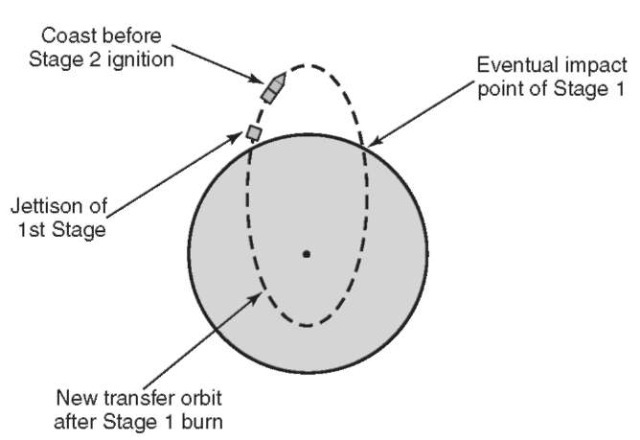
A suborbital flight that brings you all the way across the Atlantic will have almost the same speed and energy requirements as an orbital flight.
Just take a look at the typical orbit of a SpaceX second stage over the Atlantic: https://youtu.be/zBYC4f79iXc?t=32m13s - A suborbital flight that just barely goes back deep enough into the atmosphere over Africa to slow down would look almost exactly the same and wouldn't even be 100 m/s slower.
Compare that to the tiny ballistic arc of the first stage. That's how your suborbital flight would look like if you want to hit the atmosphere at a speed that doesn't require a heat shield.
There's a lot of possible trajectories, and one doesn't have use a ballistic one. Once out of the atmosphere you could leave low thrust on for the entire journey, alleviating concerns over both weighlessness and the need for excessively high speeds.
Here's a breakdown of reaching orbital speeds, vs doing a vertical sub-orbital hop. [1]
Here are some specs for an ICBM. It has a range of 6,000 miles, and has to reach ~7 km/s (Mach 23) to do so. [2]
The mathematical reason for why suborbital flights that take you somewhere require so much velocity is because all ballistic trajectories are actually elliptic orbits. When you throw a baseball into the air, it is in an elliptic orbit - a very small orbit, with most of it passing through the space occupied by the earth. The Earth's center is one of the two centers of the ellipse.
This means that in order to send a ballistic rocket to the other side of the world, you need to 'almost get into orbit'. At this point, it takes very little energy to turn your orbit into a circle... But it also means that you had to expend orbital-levels of energy to get to the point that your suborbital hop takes you somewhere. [3]
Knowing that sub-orbital ballistic trajectories are ellipses, with one of their centers at the center of the Earth, you can calculate the velocity requirements yourself by using Kepler's second law.
Great explanation, thank you. From the links you provided (all very good), I started browsing and ended up with the book "Orbital Mechanics: Theory and Applications" by Tom Logsdon [1], which appears quite good.
It also overstates its effect on total travel time-- which includes all the other nonsense (like the TSA) and planned buffering against uncertain delays that makes it frustrating. You'll burn a day crossing the Pacific either way.
It's not even so much TSA--getting through security in the US only takes me 5-10 minutes typically with Pre-Check. But I hate to feel like I'm rushing so I do build in buffer. I have to get to the gateway city (which is almost never Boston), with a reasonable allowance between flights. I'm an hour to the airport. Clearing immigration/customs can take a while. Getting into an Asian capitol from the airport can easily be another hour.
As you say, even cutting out 5 to 6 hours isn't that big a deal.
All you have to do to beat JAL first class is to set the cabin temperature to something less than 82 degrees. You basically make the mistake of flying JAL transpacific exactly once, cursing yourself for ignoring all the Flyertalk posts regarding their odd cabin temperature policy.
I hate to say it, but American is way better in this regard.
For me personally the issue is not with a flight the time but with comfort. The other day I flu JetBlue mint from LA to New York and I never felt better after the flight. The problem with my flights to Europe are incredibly narrow and uncomfortable seats and limited leg space. I just can't physically sit in those economy seats even for 2 hours...I'm 6'3" btw
It's also driven by the fact that a lot of people (and many corporate travel departments) pick flights strictly based on price so anything you can do to appear at the top of the travel agent listing sorted by price gets you business.
Fortunately I have the status to always fly my default airline with extra legroom seats.
But to your broader point. Modern lie-flat business class is far more comfortable with personalized entertainment options (and plugged in via WiFi if you want) than first class on PanAm ever was. Long flights are still kinda boring but I'm not sure they're painful enough that any but a vanishingly small sliver of people who aren't already flying in private jets would pay a huge premium for them.
The biggest reason Concord wasn't successful was the sonic boom.
This is why it only ever flew transatlantic. It was originally envisioned to also fly across the US, e.g. NYC to LA, but this was banned due to noise concerns.
Had the Concord been permitted to fly over the continental US, it could have been much more successful than it was.
Maybe I'm a bit pessimistic, but these 'might' headlines are never followed up by the real thing. It helps me to read these headlines a bit different: might = won't. In casu: Supersonic passenger jets won't make a comeback
Is individual travel time so important that we should spend our limited environmental capital and build supersonic passenger jets? The Concorde was cool and sexy and destructive. Today's passenger jets, much improved over past aircraft, are still destructive and damaging.
Wikipedia got nice list of those projects, as usual most of projects never realize.
https://en.wikipedia.org/wiki/Supersonic_transport
List of potential problems with supersonic jets is also quite long. I guess we've all would love to see progress being made.
I was just watching a documentary on the 2000 Concorde crash in France the other day. It had some really good history and technical breakdown of how it worked.
Apparently it was an unusually safe aircraft with no accidents for 30yrs until this incident. I won't ruin it but what caused it is also interesting from an engineering perspective.
The thing is that First/Business class has also been upgraded considerably as well. As has in-flight options like WiFi. And there are, for example, Business-class only BA flights between City airport in London and New York.
Even among executives/investment bankers/international lawyers, there really isn't that much demand to go back and forth from the US East Coast to Western Europe in a day which was a big pitch from the Concorde. A faster plane starts to look more interesting Trans-Pacific but that's a whole other set of tech challenges. (It's greater than the Concorde's range.)
I was thinking along the same lines - what changes in society have occurred since then that would make any one person need to expend this much fuel to get from point a to point b marginally quicker?
You'd think with advancements in telecommunications - the internet, etc - there'd be even less reason to need to be physically present in a place.
Is NASA co-operating with JAXA on this project? They've been working on a similar project for over a decade and last I heard were doing small scale tests.
Concorde made money for British Airways in every year it flew.
Originally, however, they had to return 80% of any operating profit to the UK Government in exchange for a 'Condorde Subsidy'
After BA had been privatised they bought themselves out of that agreement, ending the subsidy but pocketing the profit directly. They then proceeded to operate the fleet for another 20 years.
So, in a British context, on an operating basis Concorde absolutely was economically viable. On a program basis, considering all the development costs, it was not; but then again the Boeing 787 program is > $30 billion in deficit right now and is unlikely to ever clear that.
Yeah; on privatisation they were transferred the airframes as a 'fully depreciated asset'.
I'm full of admiration for Concorde as a technical achievement, but it's certainly easier to make a profit if you don't have to pay for your aircraft or initial stock of spares, let alone the development costs of the plane...
I think this lesson has been learned. After making losses for a while, British Airways did the research and found that people who were willing to pay for the Concorde's pricier tickets were actually willing to pay substantially more.
After BA upped the ticket prices and the wealthy customers just kept paying, the service quickly became profitable for them, and remained so until the crash.
For any new entrant to this market, it will need to remain an expensive niche.
I refuse to read an article that forces me to whitelist the site in my adblocker. Not because I'm anti-ad, but because their ad code is likely an invasion of privacy.
I don't mind paywalls, but _this_ is egregious to me. Fuck the LA Times.


Be good to see what engineers can come up with using current technology to make things stronger, faster and lighter.
Always intrigued by the fluctuations in the airline industry. I remember a time when it was said 'smaller aircraft were dead, and it is the time of the super jumbos', and now the reverse is true with airlines shunning huge aircraft for smaller aircraft that can do regional hops.
Given that the R&D and deployment process for a new aircraft type is measured over decades, it would be incredibly difficult to build a plane today that will fit the market in 10 years time. Hats off to Boeing, Airbus, Embraer et al for their efforts.