I don't think so. In WebOS there was a Web App Runtime[1] but not the whole stack is built on top of web. Contrary to Firefox OS where the device boots into a web browser, so there is no notion of 'Compiled' or 'native' apps.
I'm not sure how you can blame OS for "no apps" (business decisions), "slow hardware" (hardware manufacturer's decision, also did you notice "entry-level smartphone" in the title?). If you add "bad performance" in that context, wouldn't it be better to first check it on "fast hardware"?
Basically the only problem from this list that depends on the OS is "bad memory management". Do you mind expanding on exactly what is bad about it?
For optimum performance (especially games), you have to understand Javascript garbage collection pretty well; basically create all your objects up front in some sort of cache, to avoid stutter during GC. It's not impossible, but an annoyance that you only really have to worry about on mobile platforms (due to more limited resources).
Sure, you have to understand your platform, especially when you use GC-enabled languages. But a) asmjs is only going to improve the situation b) there's a list of people proving it's not only possible, but also not that bad in practice https://unity3d.com/showcase/gallery/?platform=324&genre=&ga...
You can say no apps about any new phone OS but FFOS especially it's missing the point.
There shouldn't be any damn apps, if you have 'The Internet' you're good. There's no manufacture defined walls between them. If there's 'FF Apps' they should work just as well on and android, iphone, windows/ whatever.
More APIs than not aren't web standards but Mozilla's ones.
And I don't see companies with real mobile OS offering (Google, Apple, Microsoft) implementing them anytime soon. So, it will stay Mozilla only APIs, not standard.
The concept is not flawed, just because some implementations have not been popular and have failed commercially. If anyone was going to produce a good implementation, I would count on Mozilla.
I've tried Firefox OS and it feels on par with early versions of Android in terms of UI/UX i.e. it is bad, very bad. Plus poor performance, lack of any app ecosystem and operators are sticking it on sub par hardware. At the end of the day, poor user experience. All said and done, Firefox OS is just something developed markets don't want and emerging markets don't need.
Furthermore, why do you say emerging markets don't need it? The other OSes do not work on low-cost handsets any more. Targeting that niche is a good idea as it gives the OS a chance to gain relevancy with users who won't be as picky as HN readers.
At every MWC when it launched to the public and pretty much every iteration since then. My company develops solutions for a telco that is one of the key backers of Firefox OS in developing countries.
Also Firefox OS is not backed by a multi-billion corporation. And developers don't get a real choice of language. So it's going to be worse for a long time. Plus all the usual problems of being the last to the market.
Firefox OS is yet another example of Mozilla apparently thinking that ideological purity alone will somehow entice users into adopting an otherwise average-to-bad software offering.
That isn't how reality works, though, obviously. Out of necessity, most users must place software usability and capability above ideology. Software like Firefox OS and Persona will never see serious adoption when they can't compete with long-established and more functional offerings at the most basic levels, even if these competitors may not be as "open".
It's an approach that doesn't work for Mozilla's offerings that are already well-established, either. Firefox has been hemorrhaging users ever since its developers stopped focusing on truly improving the user experience, and instead focused solely on copying the worst aspects of Chrome (the UI, for example), while neglecting to address the performance and resource usage problems that have long plagued Firefox.
Users need software that works. If that means using software that's "less open" or "closed", they'll do it without a second thought. Mozilla just happens to often be on the losing side of this reality these days. While "openness" can be beneficial, it needs to be in conjunction with software that's at least comparably good to its "closed" competitors. Firefox OS, Persona and Firefox are good examples of where this isn't the case, and how they're either seeing limited to no adoption, or how they're losing existing users.
Mozilla are still working on Firefox performance and are not just "copying Chrome"; I prefer FF's look to Chrome's.
Also, Mozilla are playing a smart game with FF OS. They are not selling to the high-end or even mid-end markets. They are selling it as a modern OS with much lower requirements than Android for low-end budget phones. This is a niche nobody else targets any more. It forces them to improve performance and memory usage, too.
I totally agree. IMHO: Firefox's new look is better than Chrome, and its feel has always been better. I try out Chrome every year or so, but it seems like Mozilla pays more attention to detail in their GUI design than Google.
On Android, it's also my browser of choice - fast and smooth, and it gives me the option to block third-party cookies (been surfing the web w/o them for 15 years - but no, mobile Chrome cannot allow that; we need more adver-tracking!).
While I'm a very big fan of native, optimized code (that is: C), I think FF OS has an advantage concerning memory use, because the browser and the rest of the OS share the runtime, unlike an Android phone. It also makes it easier for low-budget developers to write apps, because they don't need (a machine that can handle) an SDK, just a browser.
The chain of [favourite language] -> [Java Script] -> [native code] is unnatural, there is an extra step nobody wants.
It's as if Oracle/Microsoft was saying "oh, you can use Java/C#" while simultaneously hypocritically making every effort to make bytecode/msil a mainstream stand-alone programming language of it's own.
The chain is irrelevant for users of the language, and despite your protest, many language designers are fine with the "extra step".
And again, you have to demonstrate that mobile platforms have good language choice in comparison to the web. So please talk about all of the language choice available on iOS and Android.


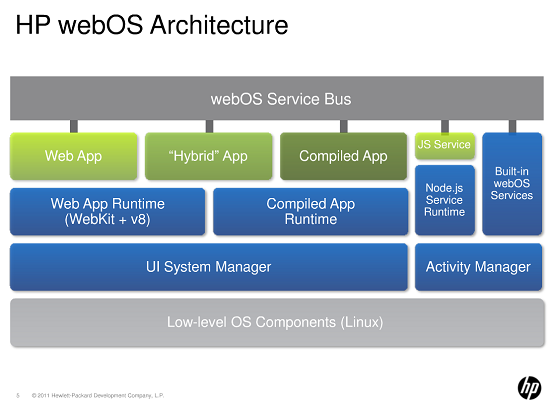
Palm WebOS has that title.